.svg)

.svg)
.webp)
Living to 120 has long sounded more like science fiction than a realistic health goal. Most people assume that aging inevitably means physical decline, chronic disease, and a gradual loss of independence.
In the third and final installment of our three-part monthly Q&A series, Dr. Jeffrey Gladden, a triple-board-certified cardiologist, longevity medicine expert, and founder of Gladden Longevity, explores what it could really take to live optimized to 120. He discusses the limitations of the traditional healthcare model, the role of diet, exercise, mindset, and joy, and how emerging technologies may reshape what healthy aging looks like in the years ahead.
Q: What Do You Say to Naysayers Who Think Living Optimized to 120 Is Science Fiction? Is It Truly a Realistic Goal?
Dr. Gladden: Well, there's certainly a lot of basis for having disbelief around that. Everything we've ever seen reinforces the idea that if you make it to 120, you won't look like you did at 30. So, I can't really fault people for being skeptical about the concept, since everything that we've ever seen would corroborate the fact that we get old and we die, and the older we get, the more disabled and shriveled up we get, so to speak.
So, I think it's a reasonable starting place. I think the thing that gives us optimism, however, is when you look at how different a 50-year-old is today than they were years ago, or how different a 60-year-old is, or a 70-year-old. The insights we've gained around even basic health maintenance have made a difference.
But when you add in the initial longevity hack, if you will, which is really hormone optimization, you start to see the impact that adequate levels of testosterone, estrogen, progesterone, DHEA, and growth hormone can have. Those hormones have made a massive impact for both men and women.
And then, when you start to layer in the science that deconstructs what is actually causing aging in the first place, along with the therapeutic application of those discoveries, you start to see that, yes, in fact, you can re-lengthen telomeres, improve mitochondrial function, improve senescent cell burden, and things like that.
All of a sudden, you see that you're really starting to chip away at the actual biological processes that are driving aging. It shifts your perspective from "Gosh, I don't think I'd want to be 120 because it doesn't look that great to me" to the fact that staying youthful has never been easier or more attainable.
So, it’s really an extrapolation of thought along those lines, coupled with the exponential growth in science and our understanding of it. When you combine today’s computing power with the rapid growth of AI over the last few years, and then consider what quantum computing may be able to contribute in the next two or three years, you start to see the potential to solve optimization problems that traditional computers simply can’t. All of a sudden, it’s not difficult to be optimistic about something you’ve never seen before.
I understand that it goes against the grain of what we’ve experienced to date. But if you have a bit of a visionary perspective, you can start to see and feel that this is actually going to be attainable. Therein lies the optimism.
But I don't fault people for being skeptical. What other basis do they have for that perspective besides what they've seen so far?
I think what’s really easy for us to underestimate is that our brains tend to work in a linear fashion. We have a hard time wrapping our heads around the exponential. When you think about the fact that knowledge is growing at whatever rate it’s growing now, compute power is increasing at its own pace, and AI is advancing just as rapidly, it doesn’t take too many cycles of that growth to see that, in the next six or seven years, by 2030 or thereabouts, we could have a massive compounded insight into this whole situation.
I think we'll have pretty much what we need to get there within the next 12 months, based on the compounding impact of everything that's going on.
Q: What Are the Biggest Obstacles To Reaching 120, and What Should People Start Doing Today to Maximize Their Chances?
Dr. Gladden: I think one of the biggest problems is actually the medical system we've grown up with because it's created a thought process that we've internalized as normal. Somebody shows up with a symptom, gets a bit of testing done, and then receives a therapy. We've been very reductionist in our thinking around medicine, in the sense that we've taken an individual and sliced and diced them into a hundred different parts. Now you've got a specialist for everything, and nobody's really talking to anybody, so people end up with very non-integrated responses to what's actually going on.
What we're building right now, with the help of AI, is a systems biology approach. That's where we're looking at all five circles: the Life Energy Circle, which is the psychospiritual space; the Longevity Circle, which focuses on the hallmarks and drivers of aging; the Health Circle, which includes all the organ systems and subsystems; the Performance Circle, which is how you stay fast, agile, strong, balanced, and maintain great cardiovascular capacity, flexibility, and mobility; and the Environment Circle, which is the environments we reside in, both internally and within our homes, offices, and the outside world.
When you deconstruct an individual's health across all five circles and then integrate it using AI through a systems biology approach, you realize every organ is connected to every other organ. There are mechanisms at play beneath what's happening independently in the brain, the heart, and every other system. Once you start taking that systems approach, your ability to improve health goes up exponentially.
I think one of the best things people can do right now is recognize the limitations of the healthcare, or really the sick care, system they've been exposed to. If you're reading this, you're probably thinking, "Well, my doctor only does this," or, "My doctor only does that." What you're really running into are the limitations of your physician's training, the insurance system, and the fact that healthcare has been sliced and diced into so many specialties.
The first thing you should do to make the biggest difference is recognize that what you really need is a systems biology approach that empowers you to get where you want to go. It's completely different thinking.
It's kind of like having a garden in your backyard where you have a specialist for every plant, and everybody is competing with their own ideas about what that one plant needs. Compare that to a systems approach, where you look not only at the plants but also at the soil, the weather, and everything else that contributes to a healthy ecosystem. You're not just spraying insecticide because someone saw a bug.
With a fully integrated approach, you don't end up with weeds or bugs, and you don't need as much fertilizer because you've orchestrated the soil so the entire system supports itself. That's exactly what regenerative farming is about. You don't need many of the things we traditionally think are essential because the system is operating the way it's supposed to. The same is true in biology. We've essentially torn people apart into individual systems without ever putting them back together.
I think the first step is understanding that this becomes possible when you change both your concept of what health looks like and the kind of healthcare you need to achieve it.
Number two is not acquiescing to the aging process as you experience it today. You've heard me say before that I wake up 27 every day, even though I was born in 1954. I went mountain biking this morning at 7 a.m. and rode extremely well. A couple of weekends ago, I was in Vail riding with my son at 10,500 feet, looping trails up there.
The point is, you can do anything you want, but first you have to claim the age you want to be. If I told myself, "Well, you're this age based on your birthday," I'd start thinking, "Maybe I shouldn't be doing that," or, "I'm not really up to that." But if I wake up 27, it's, "Yeah, let's go mountain biking. Let's go wakeboarding. Let's go body surfing."
And if your body doesn't feel up to it, don't tell yourself, "I guess that's just true." Instead, ask, "What do I need to do to make it true?" The technology exists today to help make that possible. Those mindset shifts are some of the biggest things people can do for themselves.
Of course, get good sleep, exercise every day, stop eating processed foods, give up the alcohol because it's not really serving you, and give up vaping and nicotine. Those things matter. It's also really important to stay socially active. Get out, talk to other people, stay engaged, and keep learning new things. Novelty is fantastic for your brain because it's how you stay neuroplastic.
All of those things are critical. But the overarching thing you can do, even as you're reading this, is change your mindset about how old you are. Being 27 is such a powerful tool for me because if I don't feel 27, I do what I need to do to get back there. And when I do feel 27, it's, "Let's have a great time." Life is here for enjoyment. We're here to have fun in the end.
Q: Beyond the Traditional Healthcare Model and Views on Aging, How Do Diet and Exercise Fit Into This Integrated Approach?
Dr. Gladden: Those are essential pieces. You won't get there without figuring out what diet works for you. And that's not just a question of listening to somebody who says kale is good, legumes are good, or this food is bad. It's not about hearing that MCT oil is good, so you're going to use it, or deciding to go carnivore because someone said it was great. It's not about any of that.
It's about taking the time to understand your body and what your body needs. Carnivore can be beneficial for some people with GI issues, but for most people it's actually a terrible long-term approach because it can accelerate aging. The idea of being ketogenic all the time is also a bad idea. The idea of being ketogenic intermittently is a very good idea.
People need to understand how biology works, and even more importantly, they need to understand their own biology.
The problem with diets is that they all start with the food, when they really need to start with the individual. What's your gut microbiome doing? What does your digestive system look like? How well do you tolerate certain foods? What's your immune system doing in response to those foods? Genetically, how are you built to metabolize carbohydrates or manage your vitamin requirements?
If you don't know those things, it's kind of like not knowing what kind of car you're driving. Yes, you're going to service it, but what kind of service does it actually need? That's what food is. It's absolutely critical, but it's critical to get it right, and that's what's missing most of the time.
Exercise is the same way. Exercise matters, but it's also important to get it right. Everybody talks about muscle mass as a currency of aging, and it is important. What's interesting is that it's actually very easy to build muscle at any age if you know how to do it.
The key is that even with that, you have to cycle in and out of it. Too much emphasis on building and growing increases your cancer risk and ultimately shortens lifespan. You have to balance those periods of growth with fasting, AMPK activation, cardio, and periods of calorie depletion through prolonged exercise.
Cardio is super important. Muscle is important, but VO₂ max is even more important. And I find that most people simply don't work out hard enough. They'll say, "Well, I walk every day." That's great. It's certainly better than sitting on the couch. But if you really want to be 27, you need to do more than walk.
We know that because we measure everyone who comes through here. We look at VO₂ max, anaerobic threshold, overall fitness, muscle mass, and body composition. Then we watch how those numbers change over time as people try different approaches. That shows what's actually improving their fitness and metabolic health, along with insulin control and everything that comes with it.
Getting exercise right is important. I think you should do something every single day. That way, you never have to decide whether today's the day to exercise.
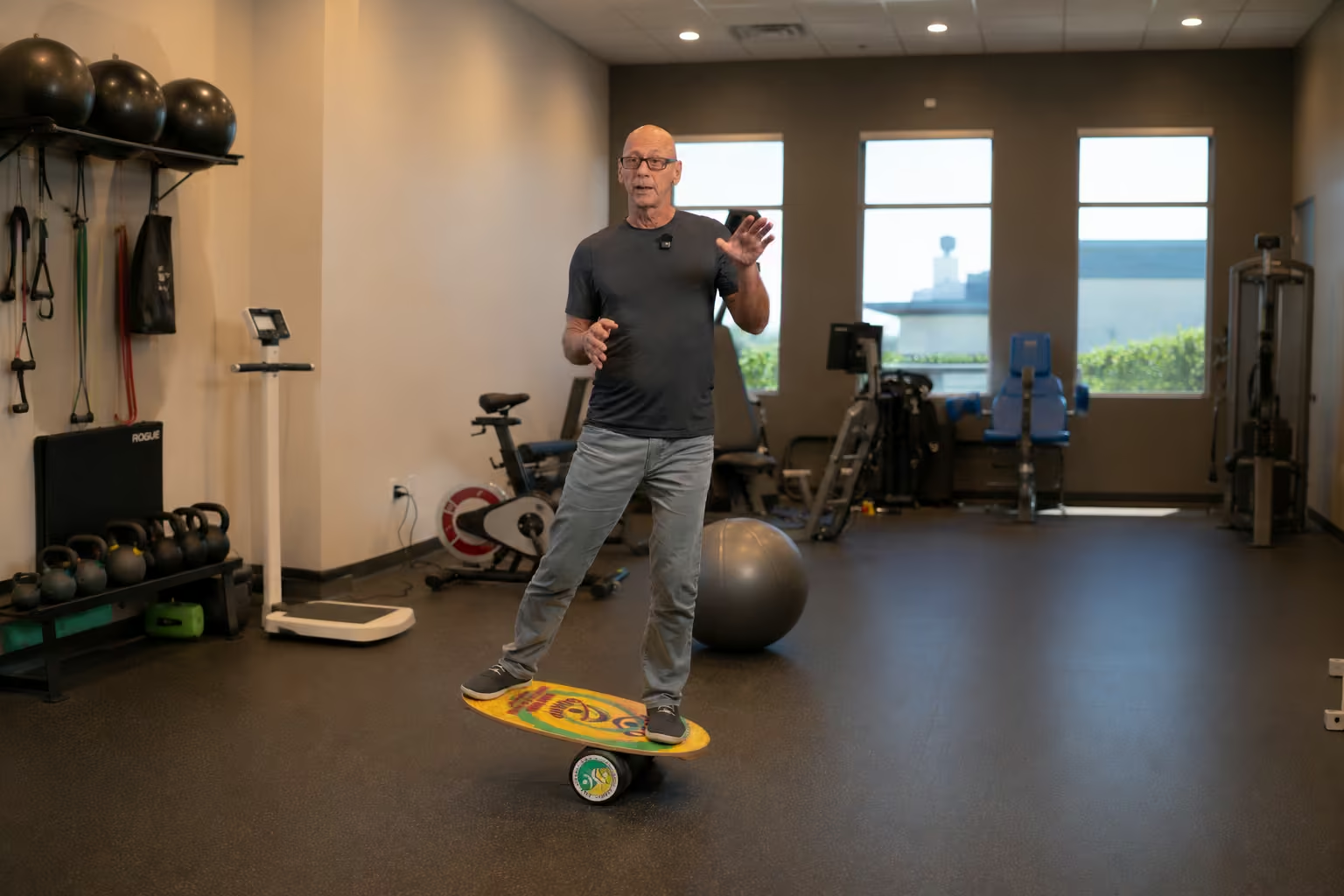
Even on days when you can't do much, put on your sneakers. Do some balance training, use resistance bands, or spend five or ten minutes moving your body. Just do something every single day. That's another mindset habit that makes it happen.
Diet and exercise are absolutely critical. But here's the interesting thing. Everybody who ate well, exercised, meditated, had good relationships, prioritized sleep, and gave up alcohol and smoking still got old and died.
The point is that while diet and exercise are foundational, they're only the beginning. They're also not as straightforward as they seem because the right diet for you is something you need to work with someone to figure out. The right exercise program is also something you need guidance to develop.
Once you get those things right, you've taken an excellent first step. But if your goal is to reach 100 with the body of a 30-year-old, or ultimately make it to 120, you've got to go much deeper than that. Everybody who only did the basics still got old and died, so if you want a different outcome, you have to go deeper.
Q: How Do You Balance the Goal of Longevity With Actually Living Life, Taking Risks, and Enjoying the Time You Have?
Dr. Gladden: I think some people get so obsessed with longevity that they become so focused on not dying that they sort of stop living. Life is about taking some risk.
One interesting thing about me as an interventional cardiologist is that I became a better interventional cardiologist once I started riding sport bikes and motorcycles. I’d always been fascinated with them, and when I got to Dallas, I bought a motorcycle. I crashed it a couple of times, realized I needed a lot of safety gear, and then took a lot of training courses.
Fortunately, I never really got hurt. But I learned that, for me, being able to have a sense of flow and fluidity, and be quick and fast yet safe at the same time, led to a mindset of managing risk. I directly translated that into the cath lab when I was taking care of patients. We were very efficient in what we did, but we also managed risk really, really well so people were safe.
I actually learned that combination from riding motorcycles. So the point is, I still take risks, right? I’m body surfing. I’m mountain biking. I bought another motorcycle a month or so ago. I mean, it’s not about not living. It’s about living.
And if I pass today on the way home, it’s been an amazing life. I wouldn’t change anything. But I don’t want to live in a closet for the sake of longevity. I actually want to live.
Q: If You Had To Design the Ideal Roadmap to 120 Using Everything We Know Today, What Would It Include?
Dr. Gladden: I think that’s a really good question, and the specifics of it will be different for each individual based on genetics, preferences, sex, and where they are in the aging process.
But I think, for me, one of the things that I’ve learned and discovered for myself is that my north star is actually joy. I ask myself, “Is this bringing me joy?” If it is, then great. I should be involved with it. If it’s not, then I probably should not be involved.
The same is true of the routine I follow for staying physically fit: eating the right foods, taking the supplements I need, the hormone injections I need, the peptides I use, or whatever else. I don't take those things because I’m focused on taking them. I take them because it brings me joy to know I can do whatever I want, right? To think sharply, to physically be in great shape, and whatever else.
So, it’s the joy. I think people can actually go into this sort of out of fear. They’re afraid that something’s going to happen. They fear decline. They fear death. And yes, that’s all part of managing risk.
But I really think you should get into this to enhance your joy, because people who have more joy in their lives are living longer, for the most part. Now, there are some ornery old people who made it, right? Some people who smoke two packs a day and whatever else. But you actually find a lot more people who are joyful. They laugh a lot, they talk, they have friends. They get together and play bridge or chess, or they go for walks together. I think finding joy and really focusing on that is super important.
Q: Which Emerging Regenerative Therapies Have the Greatest Potential To Extend Healthy Life?
Dr. Gladden: We're super excited about two things.
One is the AI systems biology approach that we're building right now, which is actually coming online even as we speak. We're super excited about that because it's going to enable us to really understand an individual and find an elegant solution for them. What do they actually need to make that garden grow? That's number one.
Number two is that we're getting access to a new therapy that's been shown to be about three times more powerful than anything we've ever had for reversing epigenetic biological aging.
We've been able, with plasmapheresis, where we remove plasma monthly and replace it with an anti-inflammatory called IgG, to reverse epigenetic biological age by nine years and six months in published studies.
This new therapy appears to be about three times more powerful than that, and it's administered as a weekly injection for 10 weeks. So we're super excited to get our hands on it. It will be offered as part of a research trial, of course, and we'll be able to allow people to engage with it.
The other thing we're excited about is seeing how this systems biology approach applies to specific areas. Right now, we're building a whole brain and nervous system program around it because so many people are concerned about their brains, whether it's anxiety, depression, cognitive decline, memory loss, or neurodegenerative disease. It's a big deal.
Again, by using this approach and the technologies we have, we can make a massive impact on people's brain health. We can also identify people who have been misdiagnosed because most brain clinics use one or two technologies to diagnose conditions and one or two or three ways to treat them.
That's inadequate. It's really just another symptom of slicing and dicing a person into a hundred different parts and focusing on only one piece. That's not how it works. Thyroid hormones, diet, the gut, and many other factors all play into brain health. If you're not looking at all of that together, you don't really have a durable solution. That's the way we think about it.
Q: If We Revisit This Conversation in 20 Years, What Do You Think Will Be Possible That Sounds Unrealistic Right Now?
Dr. Gladden: Well, I think you could almost get to a point where death becomes optional. I’m not an immortalist, but there are people out there who are immortalists.
I mean, it’s very difficult to understand how the Earth is going to evolve over the next 20 years. There’s so much going on politically, weather-wise, and with AI. There are many, many factors at play that could make the planet a somewhat inhospitable place. And maybe people will want to check out. I don’t know.
But I do think that, on the technological side, we’re going to get to a point where we really do crack the code on health and longevity. Apart from accidents and things like that, and even with the regenerative technologies, I think we’ll see things like limbs being regrown.
I think death will be relatively optional, quite honestly.

